Culture
In Defence of Thinking
By Gagan Malik
9 min read
I Got This Wrong
Last year I was building a product. Real work. The kind that requires you to hold ten variables in your head simultaneously and make judgement calls you cannot undo. I was also checking LinkedIn every forty minutes.
I told myself I was staying informed. I was tracking the impressions on my last post. I was reading replies. I was doing, at a generous estimate, 45 minutes of actual thinking per day, wrapped inside eight hours of feeling busy. I did not notice for a long time. The feed is very good at feeling like work. That is the whole design.
What broke the illusion was simpler than I expected. I sat down one morning to explain a technical problem to my team, a topic I had spent three weeks "following" online, and I had almost nothing to say. Not because I had not been paying attention. Because I had been paying the wrong kind of attention, to the wrong things, at the wrong depth, for a very long time.
That was not distraction. That was managed ignorance, delivered at scale, with a clean UI.
The Argument I Cannot Shake
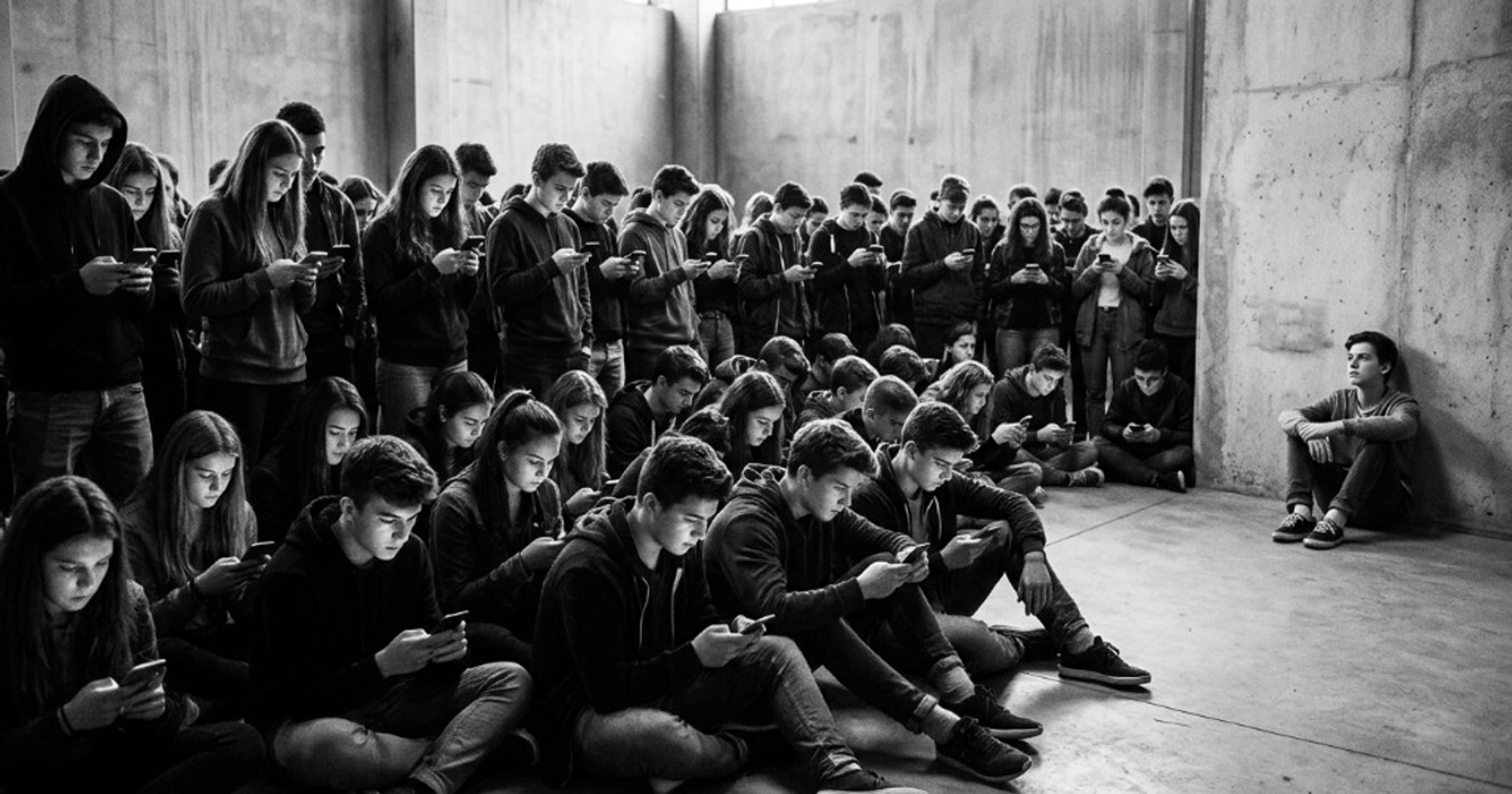
British adults now spend 7 hours and 27 minutes a day in front of screens. Ten of those minutes go to news. The rest goes to the feed. IPA TouchPoints 2025
I keep coming back to Neil Postman, who wrote in 1985 that every communication medium reshapes culture "by promoting certain intellectual pursuits, favoring specific definitions of intelligence and wisdom". He was writing about television. He died before TikTok. But he had already described it precisely: a world where the medium does not carry the message. The medium is the message. And the message right now, running underneath everything, is that thinking is optional. Slate: Amusing Ourselves to Death
He feared Huxley's 'Brave New World' more than Orwell's '1984'. You do not need to ban books. You just need to make them feel like effort in a world engineered to feel effortless. Slate: Amusing Ourselves to Death
Why the Game Is Rigged
Short-form content generates 70% of all user interactions across digital platforms. So TikTok and Instagram Reels build for short-form. Their algorithms learn that outrage and novelty hold attention longer than nuance. Advertisers pay more for held attention. Meta and ByteDance earn more revenue. The cycle does not pause. An-Nahar: economy of brain rot
Thought runs on a completely different clock. Reading something serious requires sitting with uncertainty for twenty minutes before any reward arrives. No notification congratulates that patience. No algorithm surfaces it to your followers.
Entertainment did not beat thought in a fair contest. It hired behavioural psychologists, ran A/B tests on human neurochemistry, and filed the results as product improvements. As Jay Caspian Kang wrote in 'The New Yorker', the structure of online political conversation, millions of petty arguments, makes genuine dialogue structurally impossible. The Sirens did not overpower Odysseus. They were simply better funded. The New Yorker: The Sirens Call
Among 15 to 24-year-olds in the UK, daily mobile usage is now almost five hours. The feed replaced the broadcast, and unlike the broadcast, the feed has no editor, no watershed, no obligation to the public. It has an engagement metric and an earnings call. That is the whole governance structure. IPA TouchPoints 2025
The Counterargument I Take Seriously
Access matters. A teenager with a smartphone in 2026 reaches more knowledge than an Oxford student could in 1985. The floor is genuinely higher. But the floor is not where any of us are competing.
The people I watch extracting real advantage from this moment are the ones who already have strong mental models and use the tools to pressure-test them. They go into the feed with a question and come out with an answer. The rest of us go in with an hour and come out with nothing we can use. Postman noted that Reagan proved credibility no longer meant reliability, only the impression of sincerity. We have not moved past that. We have automated it. Slate - Amusing Ourselves to Death
Raising the floor while the ceiling keeps rising is not progress. It is a more comfortable form of the same gap.
What I Am Actually Asking Myself
We spend 4.5 hours online every day. Roughly half of that is inside products owned by two companies. We are renting our thinking to Alphabet and Meta daily, and paying for the access with our phone contract and our cognitive capacity. Ofcom: UK adults online
I am not telling you to delete the apps. I deleted mine twice. They came back, and I let them. What I am trying to do now, imperfectly, is treat serious reading like a meeting I cannot move. Ring-fence the time. Rebuild the friction deliberately, because friction is not the enemy of thought. It is the condition thought requires.
Nobody is building a notification that says: 'you have been entertained enough now, please think.' That one is still on us.
Work together?
View plans or ask a question.
More on Culture
View archive

Stay updated
Add this link to your RSS reader to get new writings and updates automatically.