डिज़ाइन
When a Click Costs Nothing, You Stop Choosing
By Gagan Malik
8 मिनट पढ़ें
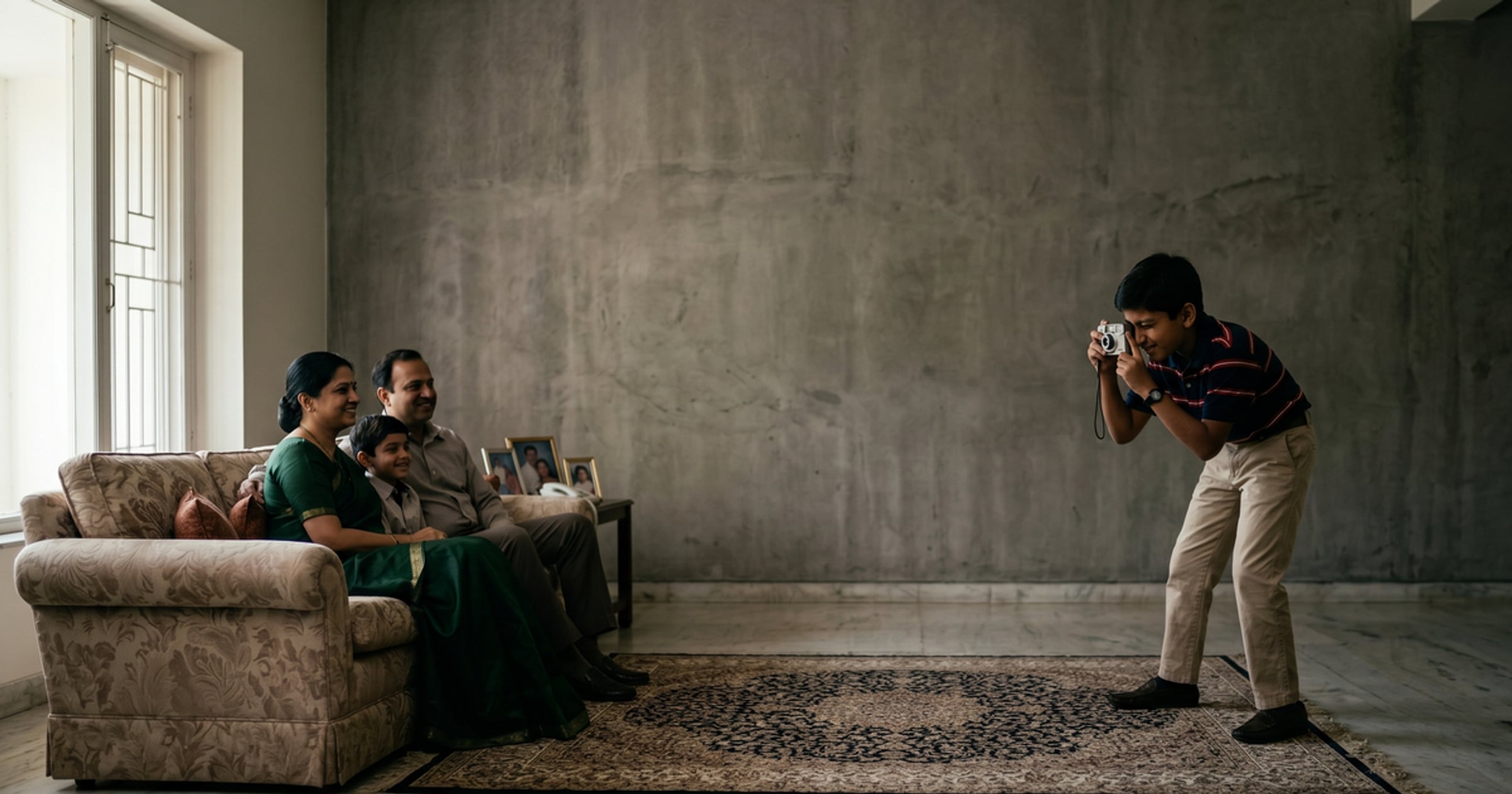
I was twelve, in Delhi, in the flat corridor outside our front door where the paint always peeled after monsoon. My father's Kodak had one frame left on the roll. He did not say "get the lighting right." He said: "Make it count. We are not buying another reel until payday."
The shutter clicked. Somewhere between that click and the prints coming back from the photo studio, you lived with not knowing. You could not delete your way out of a mistake. You could not burst-shot your way into a better version. The roll was the budget. The budget was the editor.
I am not in that corridor any more. I am on a sofa in London with a camera roll near 2,800 images I will never print, and yours may be larger. photoaid Half of them are the same face at slightly different angles. The shutter is free. Deleting is free. Regret is free too, which is why we keep producing it.
That was 1997. The maths on your phone changed in the decade after the App Store. The marginal cost of a tap went to roughly zero. We called it progress. We did not notice we had fired the editor.
You Used to Pay for the Shutter. Now You Pay Afterwards.
Film was never a moral technology. It was a priced one. In late-nineties Delhi, a colour roll and developing could swallow a week's pocket money if you were careless; by the time I was working in Britain, the high-street maths was easier to write down: about £12 all in for thirty-six exposures on a 36-frame roll, developing, and two dozen 6×4 prints, with only the frames you chose becoming paper. independent-film the3rs independent-prints Every press of the shutter was a line item. Wait three days. Collect prints. Discover you had closed your eyes in the one frame that mattered. The pain was not spiritual. It was economic.
That price did three jobs we now pretend were character: you chose before the event, you held back during it, you accepted what came back after it. Kodak and the chemists were selling consumables on a meter, not art. Digital did not abolish cost. It moved it to storage subscriptions, cloud backup, and the Sunday you spend scrolling, selecting, unselecting, quitting, returning, while someone you will never meet moderates the uploads you will never see.
Volume Is the Product. Discernment Was the Side Effect.
Cheap capture democratised photography: protests, births, rent disputes, meals that mattered, without a darkroom or a gatekeeping uncle who "knows cameras." I am not arguing for exclusivity. Cheap capture also trained us to confuse activity with judgment, because when the shutter costs nothing the winning strategy is volume. Analysts now expect more than two trillion photographs to be taken in a single year, overwhelmingly on phones. petapixel Engagement metrics reward the tenth upload, not the one keeper frame.
The product is not the photograph. The product is the tap. I have watched teams celebrate "reduced friction" the way finance teams celebrate margin: skip confirmation, auto-upload, suggest another post. Each decision is rational in a dashboard and removes the pause where a human used to ask whether this was worth keeping. We are not more creative because we click more. We are more prolific, which is not the same word.
I Know Because I Shipped the Free Tap
In 2019 I consulted on a consumer app whose north-star metric was weekly active posts. We A/B tested a flow that skipped the "Are you sure?" screen before publishing. Friction was the villain. The chart went up. I got paid. I did not meet the users. I met their behaviour in aggregate.
Maisie did. She is twenty-two, shoots weddings and funerals in Leeds, and bills herself as "unobtrusive." Last autumn she burst-shot a grandmother's service: coffin, flowers, grandchildren, wake tables, the same hug from eleven angles because storage is free and missing the moment feels like malpractice. The family wanted one image: Nan, half-smiling, nephew's hand on her sleeve. It existed in the burst. Maisie could not find it in eight hundred near-identical frames. They left a four-star review that praised her "professionalism" and privately blamed her for the one face they cannot get back. I did not think about Maisie when I removed the confirmation screen. The tap is free for the user. The cost lands on the person who still has to choose, often too late, often alone.
Junk Miles Do Not Replace a Rest Day
Runners have a phrase for this: junk miles. Legs moving, Strava glowing, fitness not improving because there is no recovery, no plan, no coach saying stop. A buffet does not teach restraint. It teaches capacity: your stomach fills before your judgment wakes up.
The old shutter worked like a coach who only let you train three times a week because film cost money. The new shutter is an all-you-can-eat line where the kitchen wins when you pile the plate. More clicks do not train taste. They train speed. Taste needs scarcity, sleep, and the courage to throw food away while it is still warm.
The Strongest Case for Cheap Clicks Is Genuinely Strong
The best objection to everything I have said is not technological. It is moral. Zero marginal cost liberated creators locked out by gear snobbery and lab fees. Nostalgia for expensive film is often nostalgia for a world where only some people could afford to be wrong in public. When critics mourn friction, they sometimes mourn gatekeeping dressed up as craft. The smartphone camera let working-class parents, migrants, activists, and teenagers own their archives without asking permission from a shop that closes at five. That is the strongest case for cheap clicks, properly stated, and it deserves to be felt at full strength before anyone lectures about curation.
About nine in ten U.S. adults owned a smartphone in 2024, Pew Research Center reported in its mobile technology fact sheet, with ownership spanning income groups even where home broadband lags. pew-mobile Access widened. Democratising the shutter is not the same as democratising peace of mind: someone still sorts the burst, someone still moderates the upload, someone still lies awake knowing the keeper frame is buried under seven hundred duplicates while the family remembers the miss, not the megabytes. Cheap capture removed the class barrier at the door. It did not remove the labour inside the house.
When a click costs nothing, the market stops choosing for you. You inherit the editor's job without the editor's training, and every product that taxes the tap on purpose is admitting what frictionless design hid. Maisie still scrolls that funeral folder on Sunday nights, looking for Nan's half-smile, while the client tells friends she was fine, just not quite worth five stars.
Three Rules Before You Take Another Burst
- Price the tap before you need discipline. Use limits that hurt slightly: one roll, one hour, one publish per day. Artificial scarcity is not Luddite. It is a user interface for judgment. If you build, tax the tap on purpose, or admit you are selling volume.
- Separate capture from keep. Shoot if you must. Choose in the same session, while the event still has temperature. The keeper frame dies in the backlog.
- Delete in public. If you will not delete, you will not curate. Admit the landfill early.
साथ मिलकर काम करें?
Plans देखें, या सवाल पूछें।
डिज़ाइन पर और
आर्काइव देखें
अपडेट रहें
नए लेख और अपडेट अपने आप पाने के लिए इस लिंक को अपने RSS रीडर में जोड़ें।